NEW ADDITIONAL DATE THURSDAY 23 APRIL, 4.30 PM
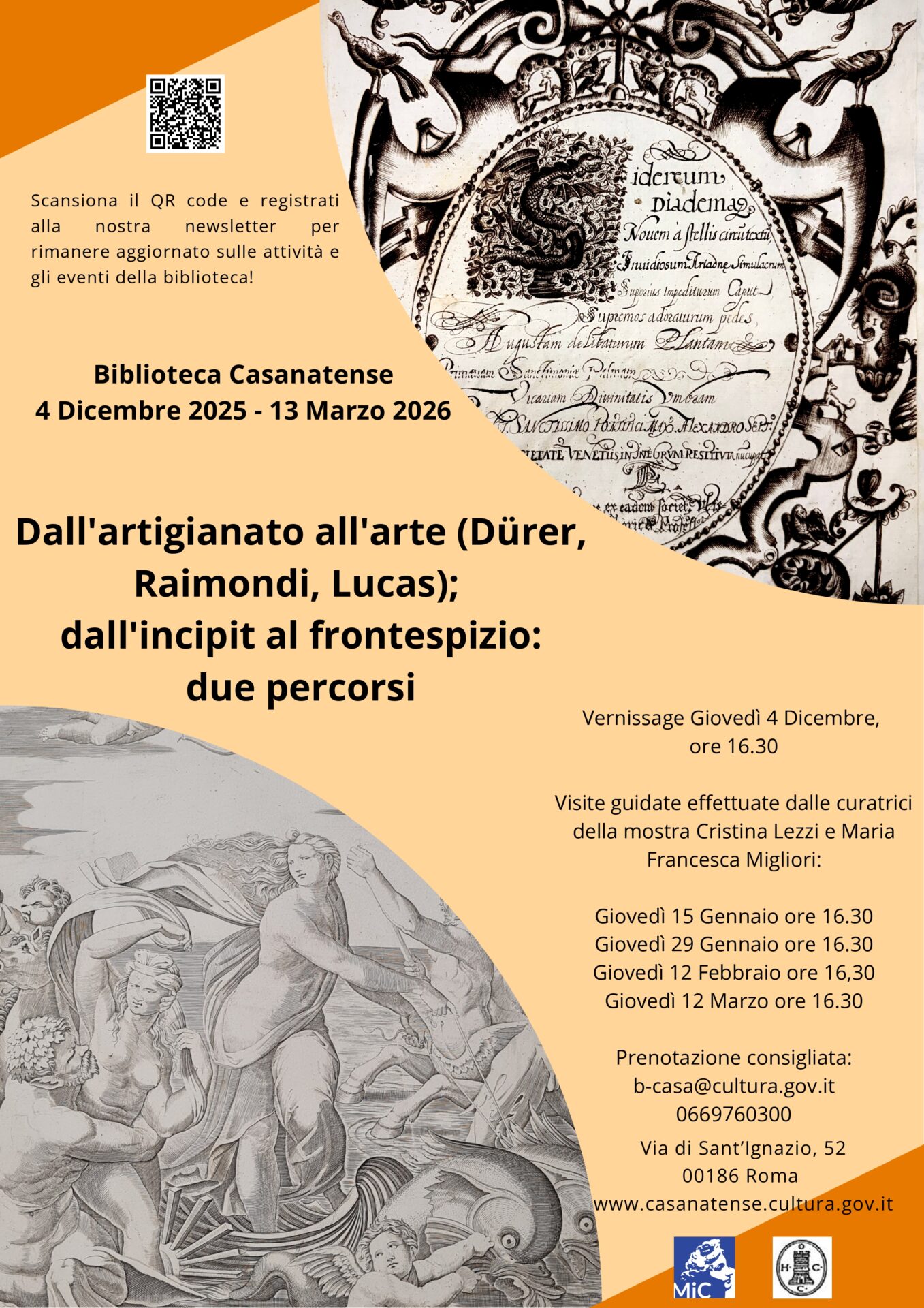
On 4 December, the Casanatense Library will open its doors to a new, significant cultural event: a true journey into the heart of art history and communication. We are pleased to announce the inauguration of the exhibition From Craftsmanship to Art (Dürer, Raimondi, Lucas); from the incipit to the frontispiece, an exhibition project that intertwines centuries of creativity and innovation. The event is divided into two thematic sections that celebrate the power of the sign: from the exceptional skills of three Renaissance engravers – Albrecht Dürer, Marcantonio Raimondi and Lucas Van Leyden – to the extraordinary metamorphosis of the text, born from the hand of the amanuensis and multiplied by the printing press. This journey is not limited to exhibiting works, but becomes an opportunity to reflect on the universal value of knowledge and the timeless beauty of the mark left on paper.
The first itinerary, spread across seven display cases, aims to highlight and raise awareness of some of the most beautiful and interesting works by three great masters of engraving: the German Albrecht Dürer, the Italian Marcantonio Raimondi and the Flemish Lucas Van Leyden, all of whom lived between the end of the 15th and the beginning of the 16th century. Three immense talents, deserving of credit for having elevated wood and metal engraving to a true art form, thus making a great contribution to the history of Italian and European art in general. In this context, given the importance and undisputed and exceptional skills of the three masters, it was deemed appropriate to exhibit the works starting with the oldest artist, Dürer, born in 1471, then moving on to Raimondi, born between 1479 and 1480, and ending with Lucas, born in 1494. The exhibition provides a broad overview of the sources of inspiration for the individual authors: from the sacred to the profane, from history to myth, to “everyday life”, touching on themes such as the lives of saints and the Virgin Mary, mythological and legendary stories, and realistic scenes depicting various trades.
The second section, spread across five display cases, aims to show how manuscripts influenced the aesthetics and structure of printed books, and how printing, in turn, transformed the very concept of text and authorship. For centuries, words were created by hand: copied, decorated and handed down by generations of scribes who transformed every page into a work of art. Then, in the 15th century, the printing press broke that ancient silence. Suddenly, books were no longer unique, but could be multiplied. Ideas could travel, cross borders, change people’s minds and lives. The exhibition recounts this extraordinary moment: the encounter between the hand and the machine, between the slowness of the gesture and the speed of printing. A dialogue that was not a break, but a transformation: the first printers were inspired by copyists, imitated their characters, preserved the illuminated initials, and sought to give the printed page the grace and beauty of the manuscript. And so, for a while, the printed book was still a manuscript disguised as something new. Through illuminated manuscripts (such as the wonderful Ms. 453 containing De bello gallico written in the elegant hand of Bartolomeo Sanvito), incunabula (such as the mysterious Hypnerotomachia Poliphili published in 1499 by Aldo Manuzio in Venice), sixteenth-century editions (such as a precious Book of Hours rich in miniatures printed on parchment in around 1533 by the Parisian Germain Hardou)
and 17th-century manuscripts, the exhibition shows how manuscripts left a profound mark on the nascent art of printing and how printing, in turn, transformed manuscripts into surprising hybrid products: handwritten texts laid out as if they were printed and often enriched with engravings and title pages that, until then, had been foreign to the world of scribes.
The exhibition will be open until 13 March 2026
Guided tours by curators Dr Lezzi and Dr Migliori, free admission with booking recommended:
Thursday 29 January, 4.30pm
Thursday 12 February, 4.30pm
Thursday 12 March, 4.30pm.
Thursday, 23 April, 4.30 pm.