
by Maria Francesca Migliori
To the sacrosanct principle of art for art (ars gratia artis, precisely) I thought of contrasting, in a somewhat playful way, a different destination, that is “art as a function of visual enjoyment”, which is the effect produced by a dozen engravings exposed on the walls of some rooms of the Library Casanatense (reception to the public and some offices located between the second and third floor of the structure), which represent the subject of this contribution.
The interest for art in all its facets was already present in the legacy of the Casanate, the first nucleus of the library, which included about 25,000 volumes. The Dominican Fathers, following in the footsteps of the cardinal, directed purchases not only to theology, but also to studies in law, economics, theater, music, engravings, history of the city of Rome, aiming at the realization of a “universal library”(1).
The sector prints/drawings of Casanatense, which consists of about 28,000 copies of loose or series prints and 1,500 volumes with text and illustrations, to which must be added 2,400 illustrated volumes dated between the XVI and the XIX century, collected under the heading “CCC”(2), preserves an extraordinary collection of engravings, in which are documented the greatest Italian, French, German and Flemish artists such as: Marcantonio Raimondi, Agostino Carracci, Salvator Rosa, Stefano della Bella, Giovanni Battista Piranesi, Bartolomeo Pinelli, Giuseppe Vasi, Albrecht Dürer, Hendrick Goltzius, Lucas van Leyden, Cornelis Bloemaert, the Sadeler brothers, the Wierix family, Jacques Callot, Gabriel Perelle and Israel Silvestre.
EXHIBITION ROUTE
a) Public reception
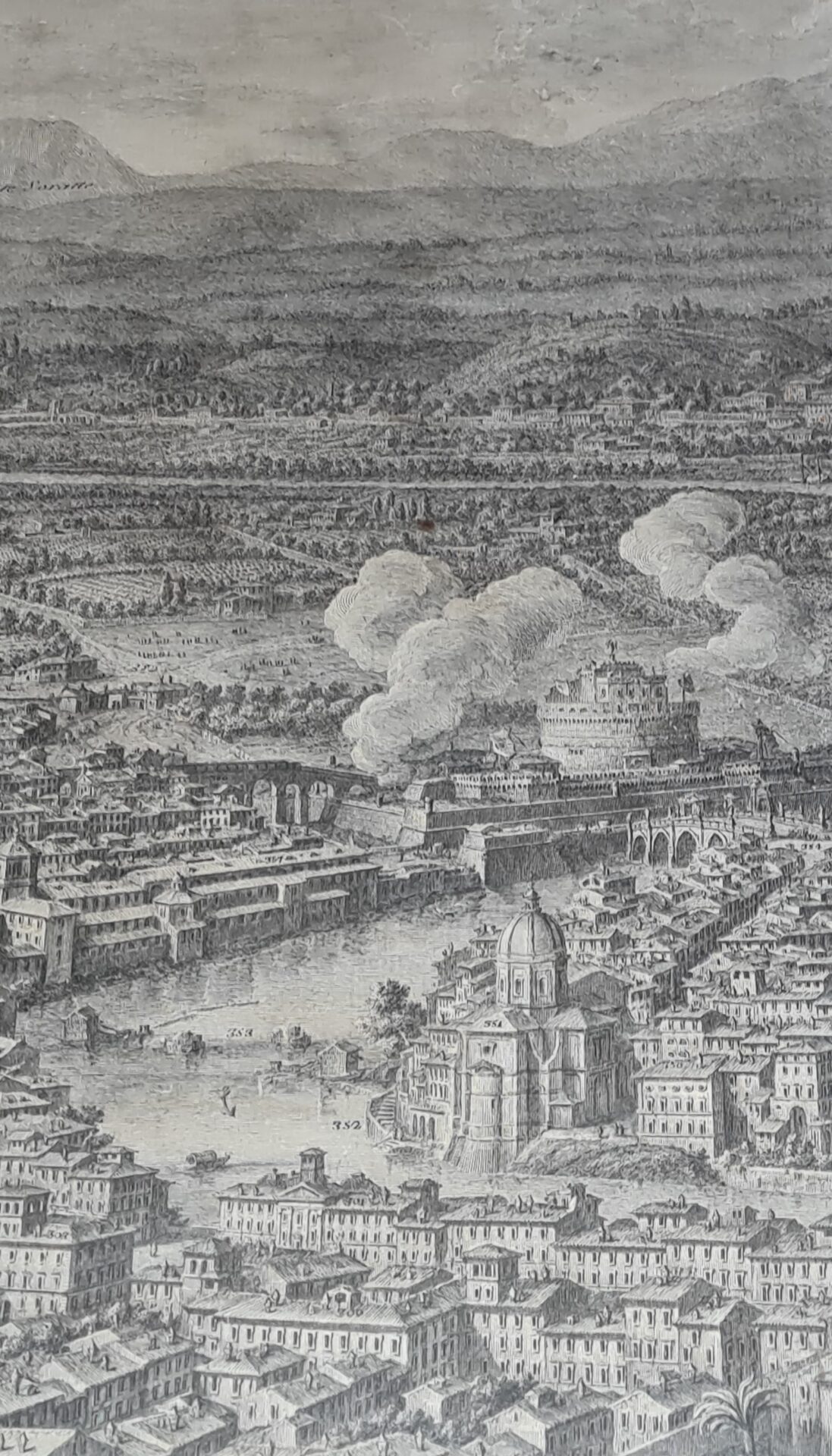
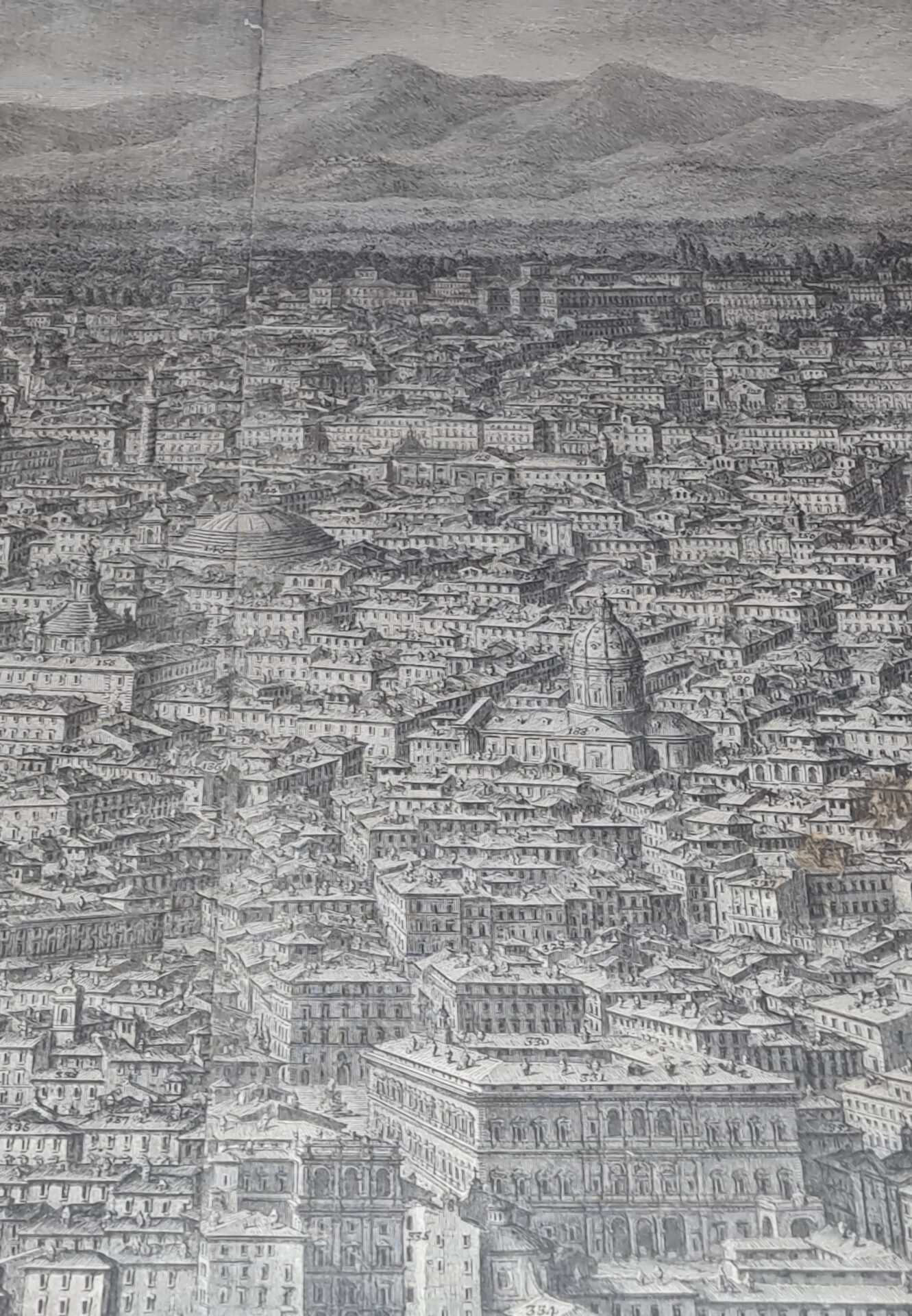
Upon entering the library, we are immediately “greeted” by exceptional print specimens, in particular the extraordinary and immense view (1120×2650 mm) of the city of Rome from the Janiculum Hill, drawn and etched by Giuseppe Vasi and published in 1765, presumably in Rome by Vasi himself.
The engraving (location in SBN: 20.B.II.157 .20), of the highest artistic level, consists of a bird’s eye view of the eternal city, presenting all the monuments and churches of Rome, which, to name but a few, range from Castel Sant’Angelo and St. Peter’s with the “Bernini embrace”, to the archaeological areas of the Roman Forum, Palatine and Colosseum valley, the church of Santa Maria in Cosmedin and the Velabro, the Tiber Island and Trastevere, the Pantheon and the entire route of Via del Corso, with its four historic districts: Pigna, Trevi, Colonna and Campo Marzio, to the more peripheral areas such as La Storta, Monte Mario, Ponte Milvio, up to the orographic conformation of Latium, with Monte Soratte, of Horace’s memory(3), dominating the backdrop of the Roman countryside, Montecompatri and Frascati.
At the bottom, amidst a thick and lush vegetation, next to the title engraved on a marble slab resting on architectural remains of fluted columns and capitals, like an overlook on the city, is the representation of the “mythical and wild origins” of the inclined Rome(4): the she-wolf(5) suckling the founding twins, Romulus and Remus, accompanied by the personification of the Tiber, a man semi-recumbent among stalks of rushes, resting his left arm on a lying amphora, from which river water flows out. All this is followed by no less than 390 toponymic indications, which make up the very detailed heading, which are divided into ‘eight days’, almost as if the artist wanted to indicate the time needed for pilgrims to visit the most important places in the city.
The Myth of Rome continues with three etchings and retouched with the burin, taken from the cycle of ten prints (location in SBN: 20.B.I.69.1-10), each measuring approximately 438×419 mm, works by Robert Van Audenaerd and published in Rome by Domenico De Rossi in 1692, reproducing Mantegna’s paintings from the series of “The Triumph of Julius Caesar”, made for the Doge’s Palace in Mantua. In detail, the prints with the progressive numbers: 4, 6, 9 are displayed in reception.
In the print marked No. 4, Roman soldiers carry symbols of triumph along the streets of Rome: tuba players, depictions of conquered cities, war insignia, the eagle of imperial power. On the sides are pilasters surmounted by Corinthian capitals and decorated with war paraphernalia. The story continues with print no. 6, in which Caesar’s triumph over Gaul is depicted with a procession of animals, including elephants adorned with decorative elements and plants, ridden by young men carrying burning torches. Also in this context, on the far right, is a pilaster decorated with a lion protome, arms, shields and surmounted by a Corinthian capital. The excursus concludes with the engraving marked no. 9, which depicts the climax: Caesar, seated on the sumptuous triumphal chariot, the wheel of which is entirely decorated and characterised by an oval panel on which a general (Caesar himself) and two mythological figures bearing cornucopias are reproduced, is portrayed clutching in one hand the sceptre with the eagle with spread wings, symbol of power and victory, and with the other the palm, while a winged Victory, like a sort of angel descended to earth(6), crowns him with laurel, as the victor; detail taken up by the presence of a soldier, in the foreground, carrying the pole, partly wrapped in a drape, surmounted by the insignia: ‘Veni Vidi Vici’(7).
With these specimens on display in the first room (open to the public) of the building, the reader entering the Casanatense is immediately captivated by the beauty and uniqueness of the heritage and seems to be immediately drawn into identifying with and entering into a reality, that of Rome, which has a millenary, unique and extraordinary history, even before beginning to read and “admire” the vast heritage preserved in the library itself.
b) Second floor offices
The artistic exhibition of engravings continues in rooms no. 14 and no. 20 on the second floor. In these contexts, the iconographic subject matter changes completely: no longer the eternal city and its history, but an introduction to the sacred, in its most courtly dimension.
As soon as one enters room no. 14 (Bibliographical Information), the visitor’s attention is immediately drawn to the engraving made in Rome by Philippe Thomassin in 1602, size: 1050×1500 mm, depicting the Allegory of the Triumph of the Church over Heresy (SBN location: 20.B.I.10.63). The Church, depicted as a large ship crowded with saints (including St. Francis and St. Benedict) and led by St. Peter, who holds the keys to Paradise, presents Christ seated on the mast, in a blessing attitude, surrounded by putti carrying the symbols of His Passion (nails, cross, column, crown of thorns, ladder, vinegar). Around the ship/church are a series of small boats that represent, each, the various heresies to be fought, while in the background are depicted the holy and turritic cities of Constantinople and Damascus: on the road of the latter took place the conversion of Saul/Paul depicted, in this context, with the same Saul who falls from a horse and with the famous phrase pronounced by Jesus, which comes out of the clouds: Saule, Saule quid Me persequeris. The iconographic and strongly symbolic depiction is completed, finally, with various battle scenes.
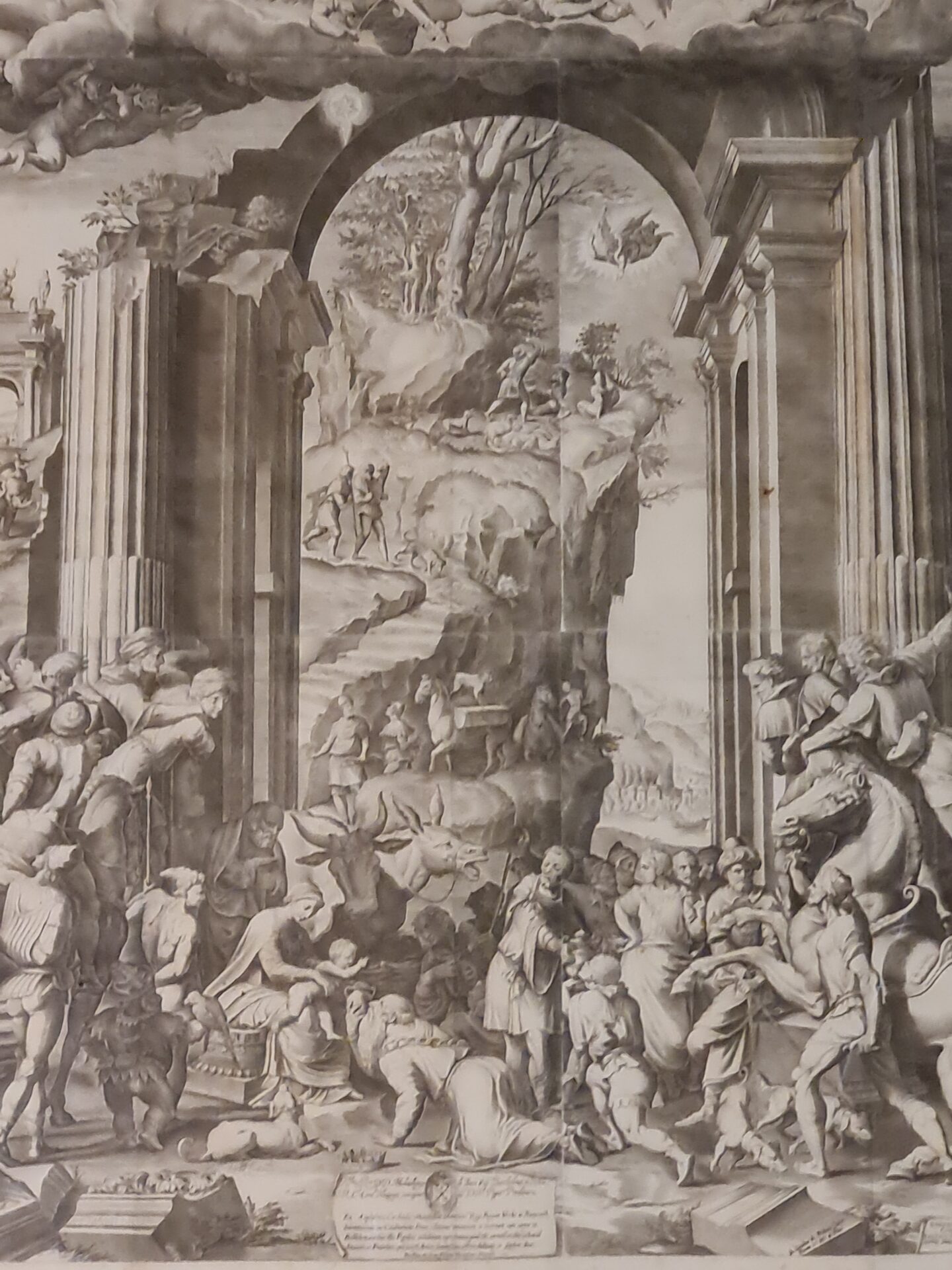
The religious subject continues with the depiction of the Adoration of the Magi (placed in SBN: 20.B.I.96.134), with dimensions: 325×565 mm, presumably published in Rome after 1579 and made with the technique of the bull by the great Agostino Carracci, reproducing an invention of Baldassarre Peruzzi and oil copied by Girolamo da Treviso, active between 1524 and 1544. The scene, very crowded with characters, depicts, high up, God carried through the clouds by a group of angels, with, on the sides, other angels playing various musical instruments. Below, under an arch with fluted columns, is the Holy Family: Joseph, standing beside the ox and donkey, Mary sitting with the Child in her arms, who, in a blessing attitude, turns to one of the kings, prostrate, who offers Him the gift of the myrrh
and, as a sign of reverence, he lays his crown on the ground; below are the other kings with the incense turnibolo and the casket containing the gold. In the distance, to the right and left, are two long processions of knights and exotic animals, including elephants, who are preparing to reach the Lord to worship Him.
Finally, the exhibition in room 14 concludes with the elegant portrait of the bishop of Auxerre, Charles Gabriel de Tubieres de Caylus (placed in SBN: 20.B.II.155.17) with dimensions: 475×348 mm, made by Georg Friedrich Schmidt using the burin technique on a drawing by Louis de Fontaine, after 1738, as can be seen from the illustration.
Another example exhibited on the second floor, but in room n. 20, is the family tree of the ancient Carafa family of Neapolitan origin (placed in SBN: *BB.V.20a), an integral part of a work in three volumes preserved in the Monumental Hall and entitled: Historia genealogica della famiglia Carafa, divisa in tre libri. … Opera del signor don Biagio Aldimari, published in Naples by Giacomo Raillard and Antonio Bulifon in 1691.
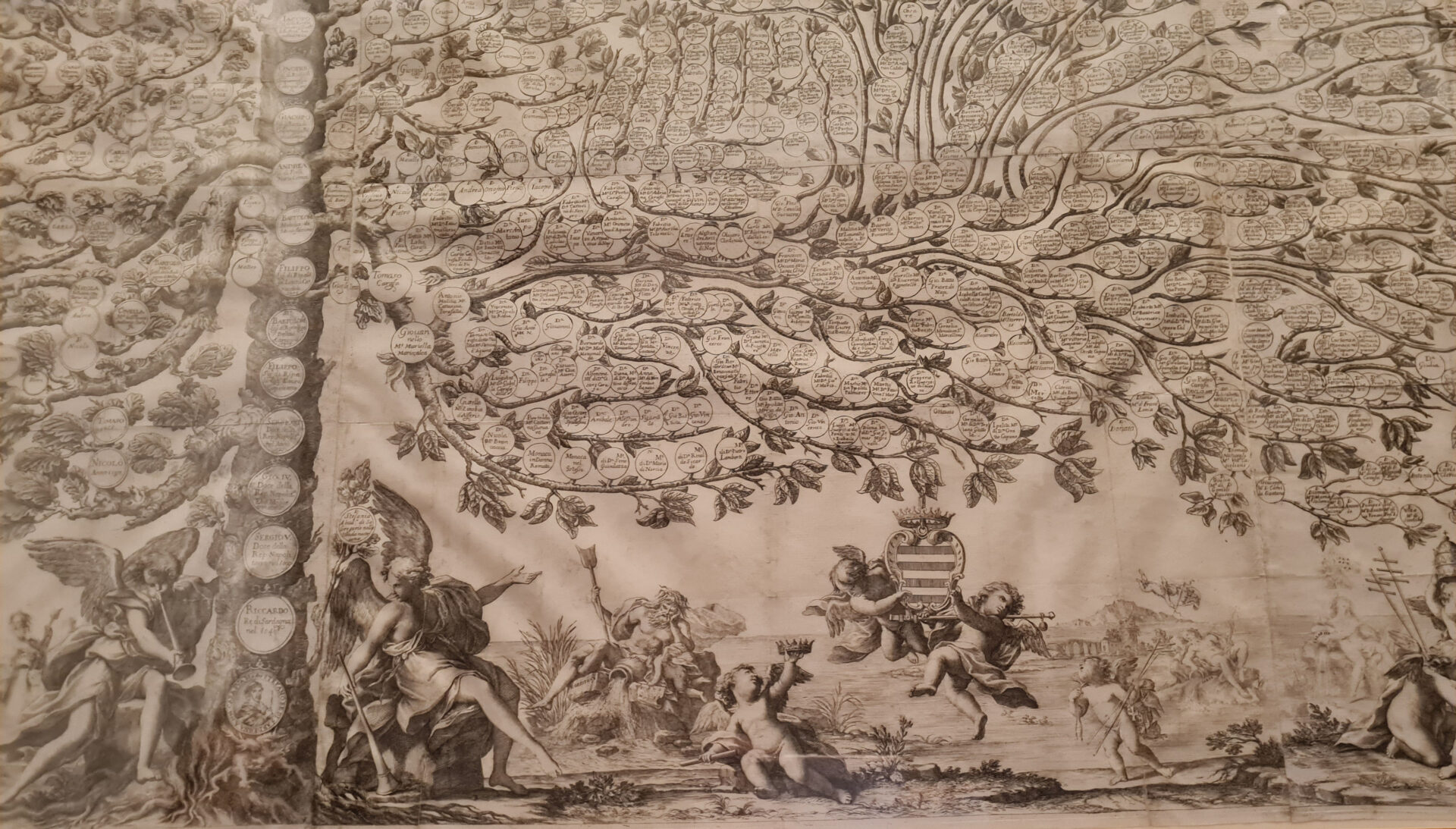
The large engraving (750×1450 mm) depicts the immense tree divided into several branches, which reproduce the various and legendary origins of the family: a putto in flight holds up a banner with the inscription “Pisa” to indicate that the founder was, according to a tradition, a young Pisan of the ancient family of the Sismondi, who would have saved the life of the emperor Henry IV, for which the sovereign, embracing him, would say “Cara fe m’è la vostra”(8) from which the surname Carafa would be derived; According to another tradition the emperor would have been Ottone I and the gentleman would have belonged to the Neapolitan family of Caracciolo.
The personification of the Tiber, the wolf with the twins Romolo and Remo and, above all, the three puppies bearing the keys of Saint Peter, a cardinal hat and the trireme are to indicate the presence of a pope in the family (Paul IV). According to Aldimari, author of the text from which the engraving was made, the family would have been of Polish or Hungarian origin, who would have translated his surname Korczak in Carafa, which would explain the presence, inside the work, the personifications of great rivers of Central-Eastern Europe such as the Rhine and the Boristene, today’s Dnpr.
The exhibition of room n. 20 ends with four engravings, two of which depict a long series of portraits of cardinals, including some who became pope, such as Paul V or Innocent X, and two depicting their coats of arms.
c) The offices on the third floor
The exhibition of fine engravings continues in the three rooms (nos. 2, 3 and 4) on the third floor of the library.
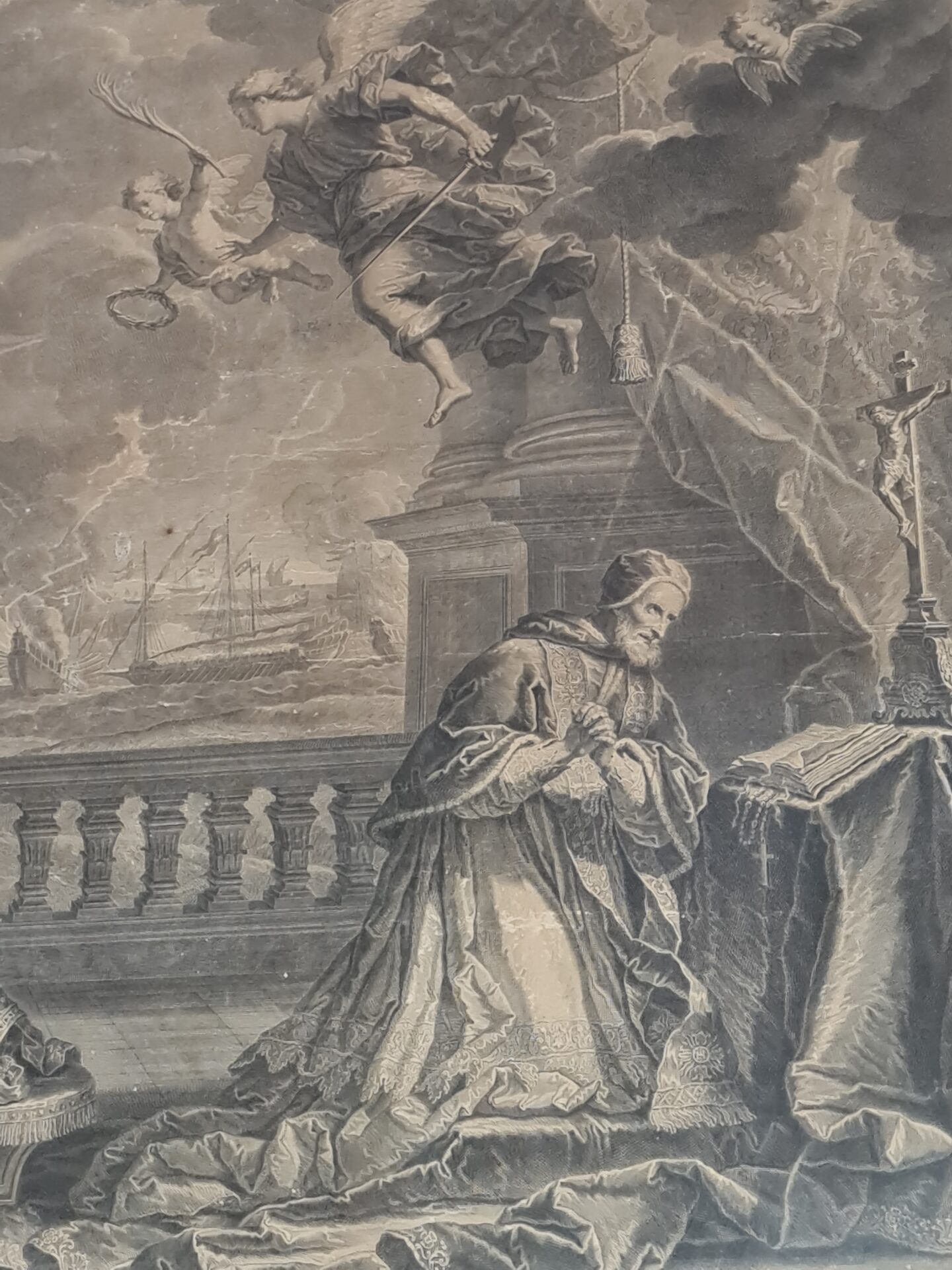
In room no. 4, which is the first one we come across, there is an etching with tinsel retouches of approximately 700×510 mm (placed in SBN: 20.A.I.17.23), made by Louis Desplaces in 1714 on a drawing by F. Jean André and published in Paris by P. Drevet, depicting Pope Pius V praying on his knees in front of a small crucifix, the Bible and the crown of the Holy Rosary (9), on a terrace overlooking the sea, during the 1571 battle of Lepanto won by the Christian fleet against the Turks (10). Two angels are camped high, one in the foreground, with a wide tunic, holding a sword and looking at the other naked and in the background who, instead, holds with one hand a twig of palm and with the other the crown of victory, to indicate the imminent victory of the Christians but, Presumably, even the sharp contrast between war and peace.
The exhibition continues in room n. 3 with the extraordinary etching with retouches to the burl, of dimensions: 721×1360 mm approximately, depicting the Panoramic view of the port of Ancona (placing in SBN: 20.A.I.42.50), engraved by Giuseppe Vasi on a design by Luigi Vanvitelli and published by Calcografia Camerale al Piè di Marmo (11) after 1738, dated from the dedication of Vanvitelli to Cardinal Neri Corsini (Ancona 8 December 1738). At the centre are the spaciousness of the sea, the boundless horizon, the slight movement of the small waves made by Vasi with great mastery in the use of etching techniques, with his typical “vibrato”, and the bulino.
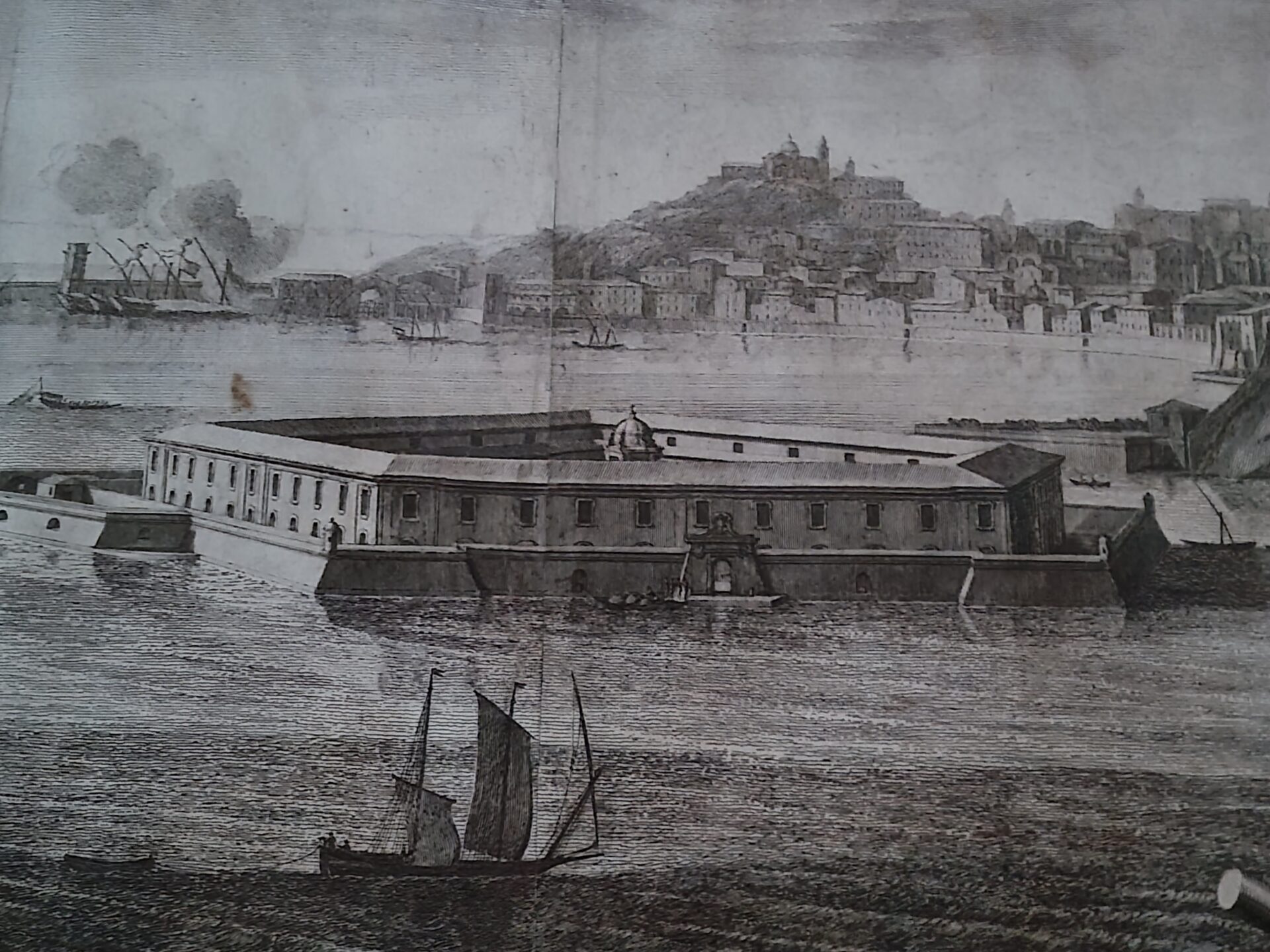
All around are, like decorations, some views of local buildings, until reaching, at the bottom, more symbolic representations such as the armillary sphere, which represents the celestial vault, geometric tools for drawing, weapons and a cannon.
The exhibition concludes, in room n. 2, with the print depicting the Gospel episode of the Massacre of the Innocents, etched by Alexis Loir between 1650 and 1674 on a drawing by Charles Le Brun, with dimensions of approximately 660×937 mm (placed in SBN: 20.B.II.157.19). At the centre of the scene are the soldiers, some of whom tear children from their mothers’ arms, others inflict the fatal blow, still others fight with desperate mothers who try in every way to save their own children from their murderous and unjustified fury, some of which also resorting to bites on the arms of the persecutors. In the background, along the walls of the city and in the confusion, continues the bloody and desperate struggle of mothers against the tormentors of their children.
The engravings on some walls of the library are only a microscopic sample of the exceptional graphic collection owned by Casanatense. The choice of specimens also touches on various themes and types: from the cult of ancient Rome with the Triumphs of Julius Caesar to the splendor of eighteenth-century Rome represented by the Vases: that Rome where the library strongly desired by the Casanate originated and evolved, in the heart of the city, a few steps from Via del Corso and the magnificence of the Pantheon; passing by sacred representations with immense symbolic value, such as The great nave of the church that triumphs over all the heresies, or the Epiphany of the Lord, manifestation of God to men and prelude of the Passion, Death and Resurrection, culmination of the “Christian creed”; until reaching the genealogical tree of a prestigious family, the Carafa, but also to the representation of historical events such as the Gospel account of the Massacre of the Innocents or the episode of the Battle of Lepanto, in which triumphs, undisputed, the Christian faith; up to a more profane argument, like the View of the port of Ancona, Once again a work of the Vasi, with its natural beauties and architectural wonders, designed by another genius of art: the Vanvitelli.
Note
(1) MUSSETTO, B. 2019, p. 83.
(2) MUSSETTO, B. 2013, p. 65.
(3) Vides ut alta stet nive candidum / Soracte … Hor. Ode, 9, v. 1 e sq.
(4) As it was defined by the Latin poet Ennius in Annales, XVIII, 3: “Septigenti sunt paulo plus aut minus anni / augusto augurio postquam inclita condita Roma est”.
(5) The she-wolf, like the woodpecker, was considered by the ancients as a “guide” animal to establish the geographical location of a people.
(6) Hall J., p. 424.
(7) Expression with which, according to tradition, Caesar announced the victory of 47 a.C. against the army of Farnace re del Ponto.
(8) MORONI, G. p. 236.
(9) The victory of the Christians over the Turks in the naval battle of Lepanto was attributed to the power of the rosary. Hall, J. P. 270.
(10) Before the departure for the battle, the pontiff had blessed the banner of the Holy League depicting on a red background the Crucifix between the apostles Peter and Paul and surmounted by the Constantinian motto In hoc signo vinces.
(11) The Via del Piè di Marmo, named after the presence of a huge foot belonging to a gigantic statue coming from the Iseo Campense, the largest temple of Egyptian worship present in the city of Rome in ancient times (in the area of Piazza di Sant’Ignazio), is located next to the Casanatense Library; this indicates how important this place has been in the history of the city over the centuries … not only from a cultural-historical and religious point of view, but also in terms of printing
BIBLIOGRAFIA
DE GREGORIO Vincenzo, La Biblioteca Casanatense di Roma, Napoli, Ed. Scientifiche Italiane, Pubblicazioni dell’Università degli studi di Salerno …, 1993, vol. 23, pp. 233-235.
HALL James, Dizionario dei soggetti e dei simboli nell’arte, Milano, Longanesi 1983.
MORI Virgilio, La raccolta di stampe della Casanatense di Roma, estratto dall’Almanacco dei bibliotecari italiani, Roma, Fratelli Palombi Editori, 1968, pp. 91-98.
MORONI Gaetano, Dizionario di erudizione storico-ecclesiastica da S. Pietro sino ai nostri giorni, In Venezia, dalla tipografia emiliana, 1841, vol. IX, pp. 236-237.
MUSSETTO Barbara, La collezione iconografica della biblioteca Casanatense, Biblioteca Potestas. Los Habsburgo. Arte y propaganda en la collecion de grabados de la Biblioteca Casanatense de Roma, Castelló de la Plana, Publicacions de la Universitat Jaume I, 2013, pp. 65-69.
MUSSETTO Barbara, Artur Wolynski: un rivoluzionario polacco a Roma e in Casanatense, La Polonia e l’Italia nel dialogo tra le culture, Warszawa, Wydawnictwo Naukowe Uniwersytetu Kardynała Stefana Wyszyńskiego, 2017, pp. 101-104.
MUSSETTO Barbara, San Giuseppe e la Sacra Famiglia nel fondo antico della Biblioteca Casanatense di Roma, De Domo David la confraternita di San Giuseppe Patriarca e la sua chiesa a Nardò. Studi e ricerche a quattro secoli dalla fondazione (1619-2019), a cura di Marcello Gaballo e Stefania Colafranceschi, Nardò, Fondazione Terra d’Otranto, 2019, pp. 83-85.
OLIVIERI Iolanda – VICINI MASTRANGELI Angela, In praesepio. Immagini della Natività nelle incisioni dei secoli XVI-XIX, Roma, Istituto Poligrafico e Zecca dello Stato, 1987, pp. XI-XIII.
OLIVIERI Iolanda, Oltre il testo, in Biblioteca Casanatense Roma, a cura di Angela Adriana Cavarra, Firenze, Nardini Editore, 2005, pp. 46-49.
PALLOTTINO Massimo, Origini e storia primitiva di Roma, Milano, Rusconi, 1993, pp. 15-25.
SCOPPOLA Francesco – VORDEMANN Stella Diana, Museo Nazionale Romano: Palazzo Altemps, Milano, Electa, 1997, pp. 61-62.
VICINI MASTRANGELI Angela – OLIVIERI Iolanda, La collezione di stampe, La Biblioteca Casanatense, ideazione e presentazione di Carlo Pietrangeli, Firenze, Nardini Editore, 1993, pp. 173-222.
VICINI MASTRANGELI Angela, Stampe e disegni, Emptus Anno … Acquisti in antiquariato 1990-1996, Vigevano, Diakronia, 1997, pp. 104-137.